The four seasons on one table
| Season | What the weather does | The look worth taking from the ground |
|---|---|---|
| Winter | Freezes and thaws within a week; ice can build at the eaves | Roof edge from the yard; attic boards near the eaves |
| Spring | Stains show once the thaw is over | Top-floor ceilings, chimney metal, vent pipes |
| Summer | Thunderstorms drive rain sideways and move branches | Shingle pieces in the lawn, vent caps, gutters |
| Autumn | Leaves and tropical rain load the gutters | Gutter runs, downspout outlets, soil under them |
Winter: a January that straddles the freezing line
At Newark, the National Weather Service's 1991-2020 normals put January's average temperature at 32.8 degrees, with a normal high of 40 and a normal low of 25.5. Snowfall for the month averages 9.1 inches. A roof under those numbers can freeze and thaw within the same week.
The state climatologist at Rutgers puts annual snowfall in northern New Jersey at 40 to 50 inches. Snow that melts high on the roof and refreezes at the eaves forms an ice dam. According to the Building America Solution Center, the melt starts with warmth leaking from the house into the attic. Ice dam damage shows what that looks like indoors. Newark is the station behind these figures, so conditions at your address can differ.
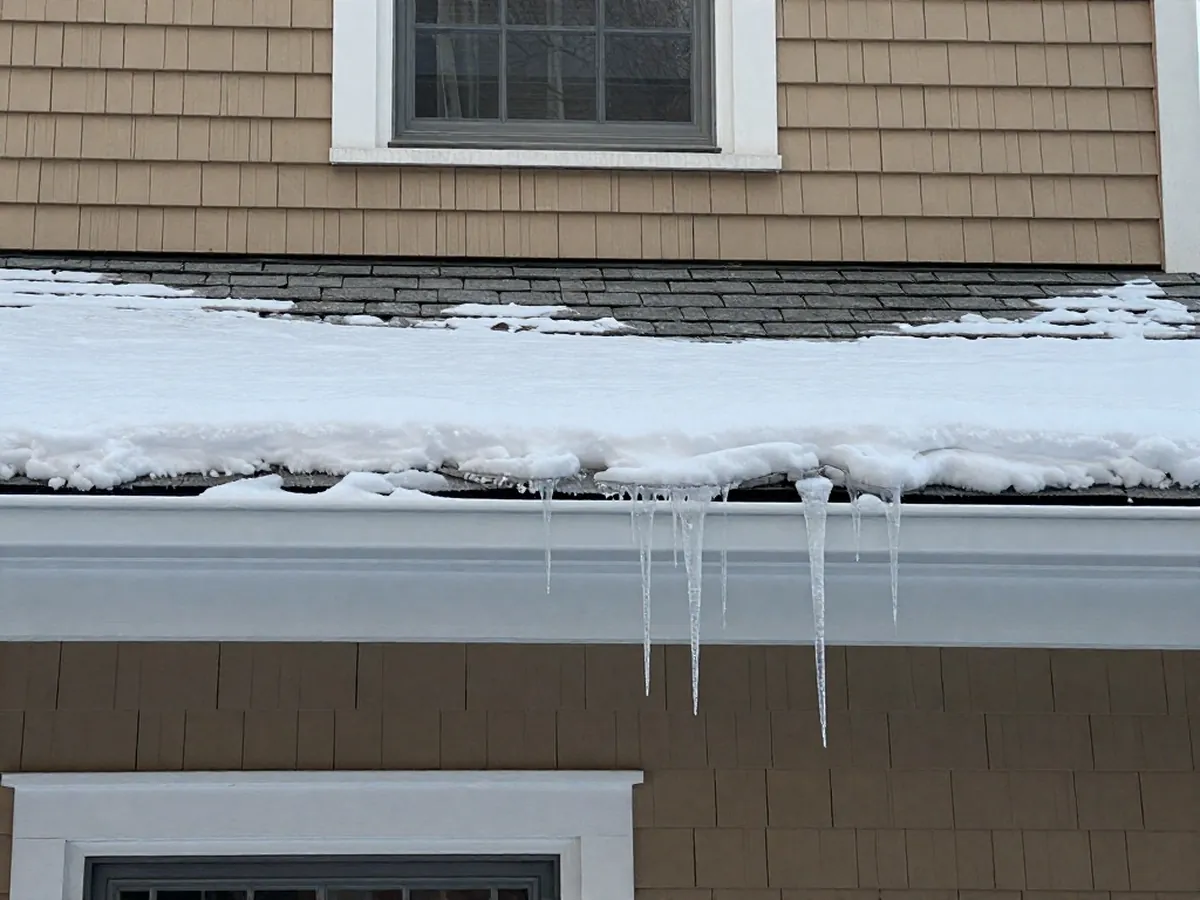
Snowy eave with a few icicles above a tan-sided window
Late winter into spring: reading what the cold left behind
Stains tend to announce themselves when the thaw is over, on top-floor ceilings and along the walls beneath the eaves. The asphalt roofing trade group recommends a professional look at low-slope roofs every spring and fall. The National Park Service advises checking flashing at least once a year for gaps, cracks and missing pieces.
From the yard, the places to check are the chimney metal, the vent pipes and the roof edge. From the attic hatch, the boards near the eaves. Photograph anything odd with the date, so the next look has something to compare against. The chimney flashing job covers the metal at the brick.
Summer: the July heat and the thunderstorm count
Newark's July normals are an average of 78.2 degrees, a high of 86.9 and a low of 69.4, with 4.66 inches of rain. Rutgers says most of New Jersey sees 25 to 30 thunderstorms a year and that the northern zone has about twice as many as the coast.
A thunderstorm drives rain sideways and throws branches around. The ground-level look afterward is simple: shingle pieces in the lawn, a gutter that moved, a vent cap that lifted. Wet shingles and ladder rungs are slippery, and the look can happen from the grass.
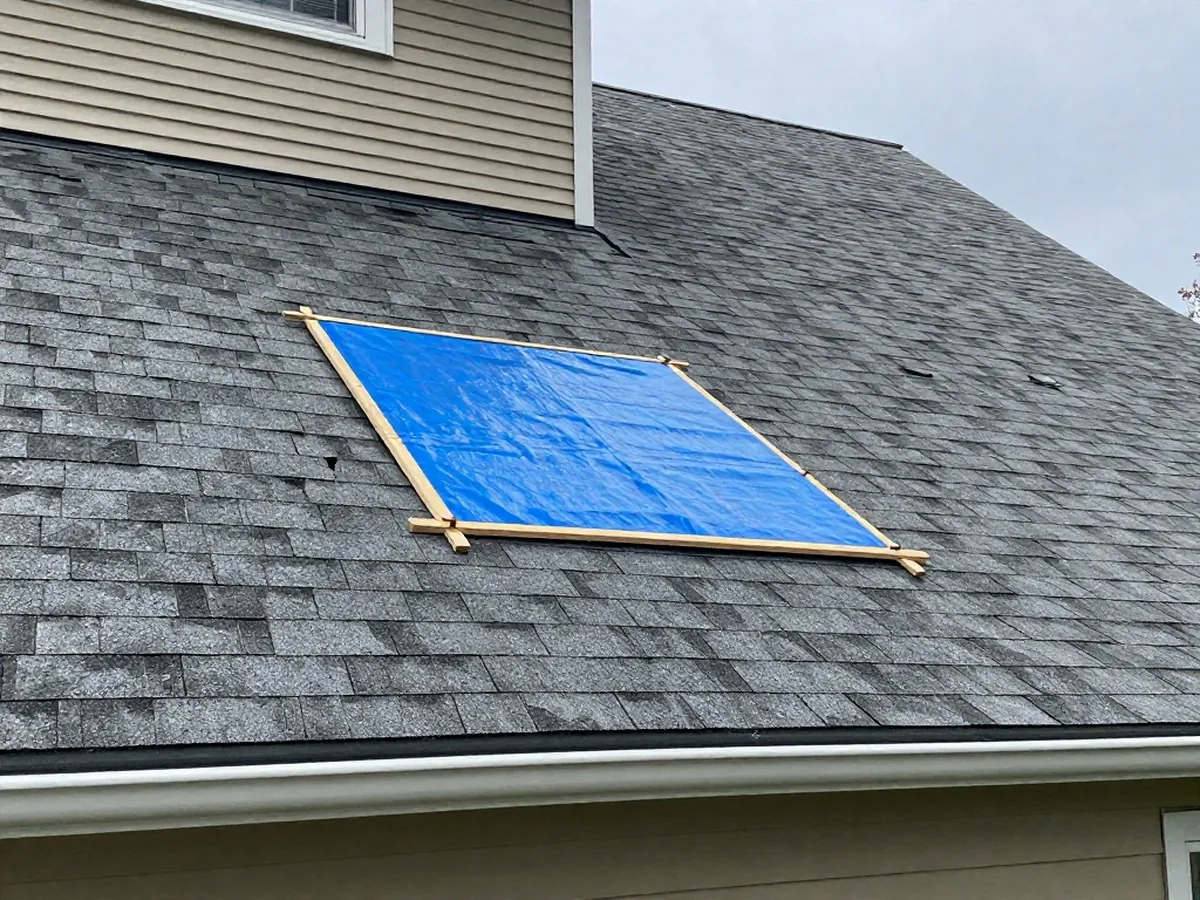
Small blue tarp nailed flat in the middle of a gray slope
Late summer into fall: the tropical season
The National Weather Service dates the Atlantic hurricane season from 1 June to 30 November. Its safety page warns that roofing material can become a flying hazard in high wind. It also says rain from these storms can flood places hundreds of miles inland.
Local records back that up. The Passaic River at Pine Brook crested at 24.12 feet on 30 August 2011, during Irene. Isaias, on 3 and 4 August 2020, left more than a million New Jersey customers in the dark. The state weather network says some waited up to five days for power. The remnants of Ida came next. Over 1 and 2 September 2021 Newark Airport collected 8.44 inches, including 3.65 inches in its single wettest hour. The highest Morris County total was 7.65 inches, at Long Hill Township. After a storm like those, storm damage repair is where to look.
Autumn: leaves, gutters and the ground underneath
Leaves are the usual autumn job. The asphalt roofing trade group wants debris cleared from the gutters and the roof so water can drain, with care on the ladder.
A Rutgers Cooperative Extension calculation puts numbers on it: a downspout fed by 800 square feet of roof moves roughly 500 gallons during one inch of rain. Rutgers advises sending the water to ground that can soak it in. The EPA lists a rain barrel, a lawn or a garden, and says disconnecting a downspout may not suit every location. Where that water ends up has its own page: where the water goes.
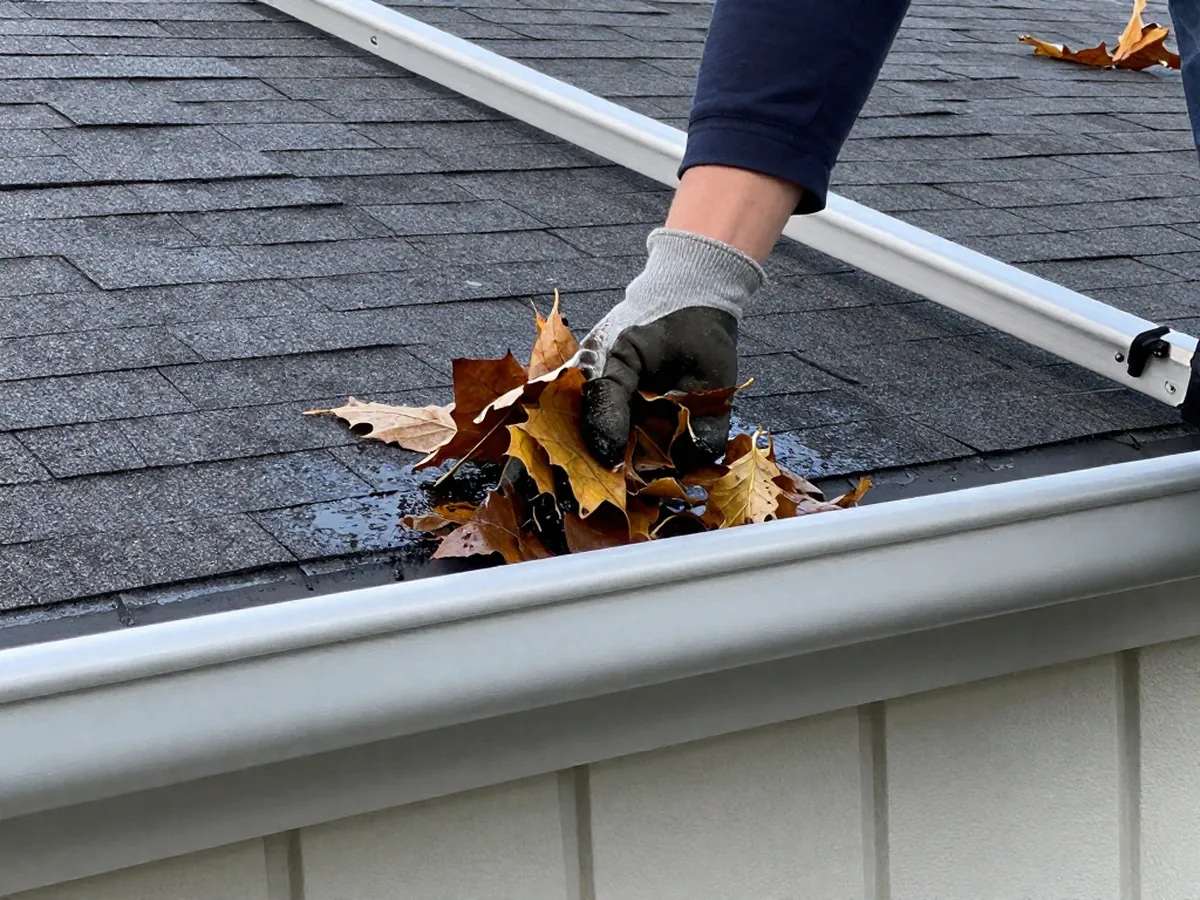
Gloved hand clearing leaves from a gutter on a gray roof
Any month: the ladder and the wire
NIOSH counts more than 100 deaths a year in the United States from ladder falls. Its advice is short. Keep three limbs on the ladder. Set an extension ladder at about 75 degrees on level ground. Stay at least ten feet from power lines.
JCP&L's newsletter says to stay at least 30 feet from a downed power line and 100 feet from a downed high-voltage transmission line. It also says to call 911 to report one. Its outage line is 888-544-4877. Any roof task that puts a ladder near a wire belongs to a professional.
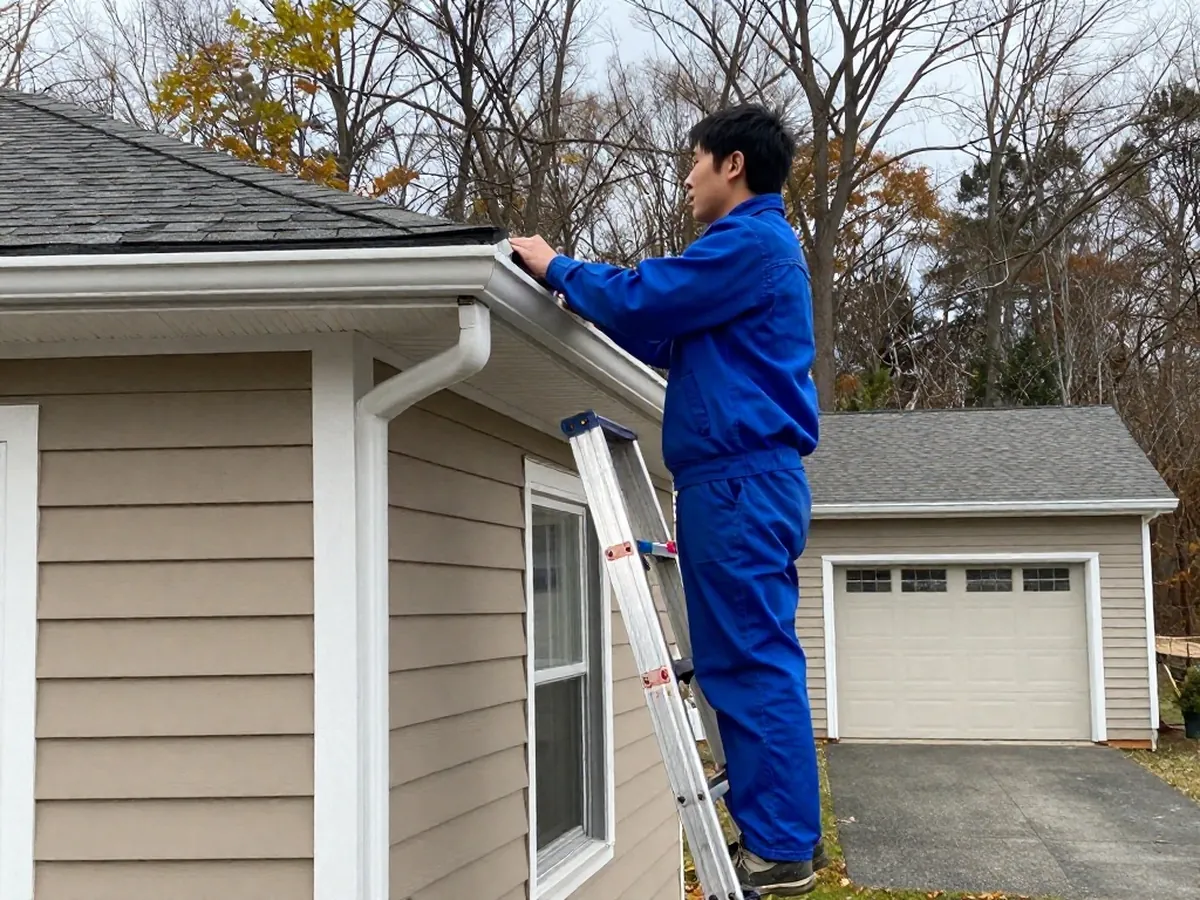
Roofer on a ladder at the eave of a tan colonial with a garage
When does a season check turn into a call?
The checks above all happen from the ground, and they stop where a ladder would start. Missing shingles, a stain that keeps growing, metal that has lifted or an ice ridge that is wetting a wall are the signs to act on. A roof inspection gives a roofer a look at those places, and roof repair covers what the look turns up.
Call (862) 430-2399 and describe what you saw, step by step as it happened. If you rent, your landlord decides on roof work, so the first call goes to them.